Lab 2.4 - Ship reference data and a batch with deployment actions
Level: 2 Contributor advanced
Time: ~30 min
You will: meet the worst kind of failure, the one where nothing fails, and fix it with three deployment actions of three different kinds.
The situation
US-026 - Crew capacity reference data and nightly recalculation
As a planner, I want capacity rules per crew type and a nightly job that recalculates them, so that the planning board is right every morning and I get a summary of it in my inbox.
Acceptance criteria:
- 12 Crew Capacity records exist in every org
- The batch is scheduled nightly
- The planner receives the morning summary email
You build it, the deployment is green, everyone signs it off, and three weeks later a planner says the board has never updated. The metadata arrived. Nothing else did.
A deployment carries metadata. It does not carry records, it does not carry scheduled jobs, and it does not carry anything a human had to click in Setup. Every one of those has to be declared, or it happens once in your org and nowhere else, forever.
Before you start
- Lab 2.3 finished and merged
-
helios-devlevel withintegration
Steps
1. Take the story and build the metadata
New User Story (2), under Project Contribution Workflow (1) of the DevOps Pipeline
panel. Name US-026-crew-capacity-data, org helios-dev.
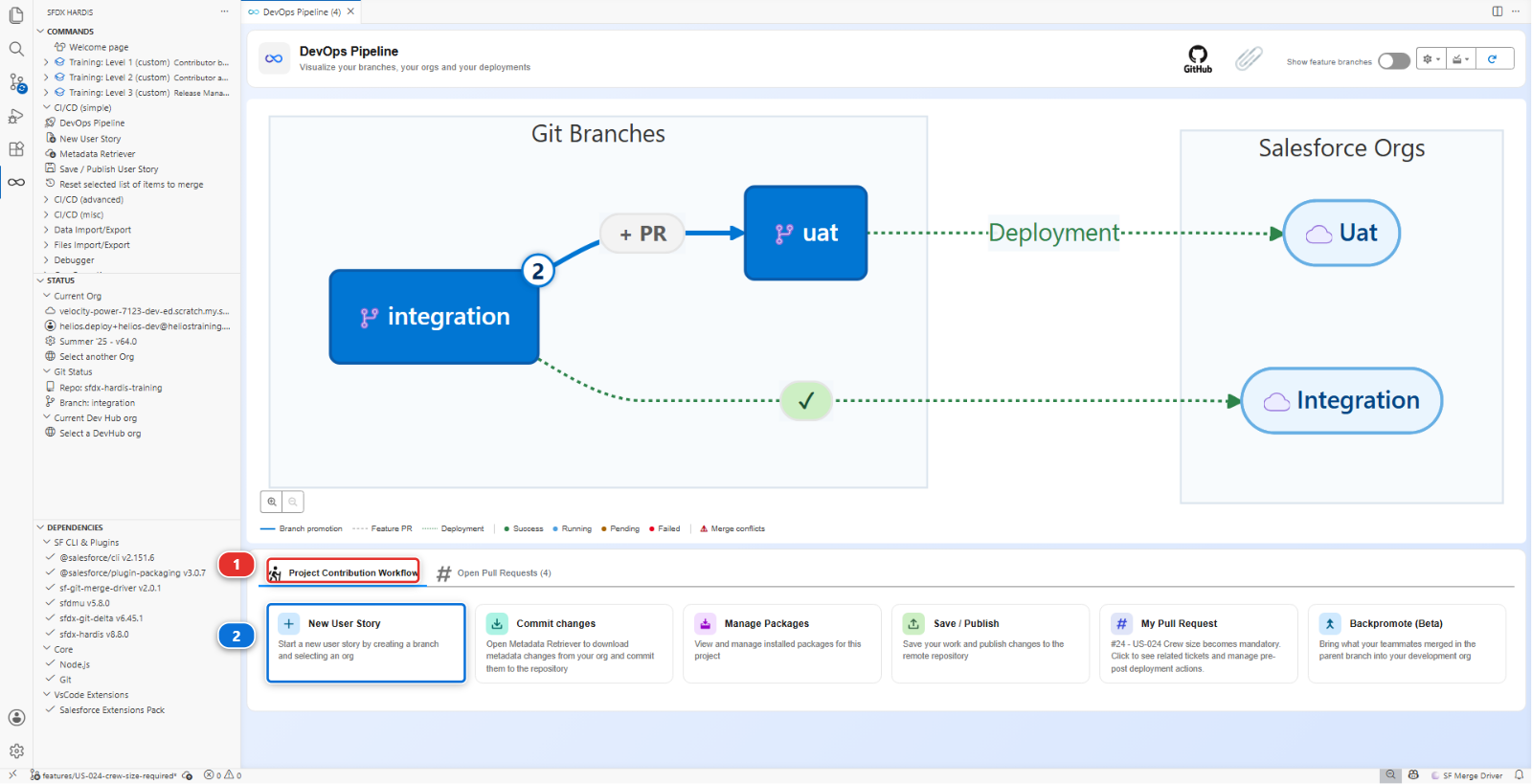
In helios-dev, create:
- A custom object Crew Capacity (
Crew_Capacity__c), with:External_Id__c, Text 40, External Id, UniqueCrew_Type__c, Picklist:Roof,Ground,ElectricalRoof_Type__c, Picklist:Tile,Slate,Flat,MetalPanels_Per_Day__c, Number 3,0
- An Apex class
CrewCapacityBatchthat recalculatesTotal_Capacity_kW__con planned installations and that Salesforce can run on a schedule, plus its test classCrewCapacityBatchTest. You do not have to write these. Copy them fromscripts/apex/samples/in the repository: what they compute matters far less here than the fact that somebody has to schedule them in every org, which is the whole point of the lab - The access, on Helios Delivery Manager: Read, Create and Edit on Crew Capacity, and Read and Edit on its four fields. Planners maintain these numbers, and it is also the permission set the pipeline's own user holds in every org: without it the data load of step 4 would find fields it is not allowed to write
Then create 12 Crew Capacity records in your org, one per crew type and roof type combination that Helios supports.
2. Publish and watch nothing fail
Retrieve the object, its fields, the two Apex classes and Helios_Delivery_Manager with Commit
changes, commit them, then Save / Publish, push, Pull Request. The check is green. Merge. The
deployment is green.
Now open helios-integration and look:
Crew_Capacity__cexists, with zero recordsCrewCapacityBatchexists, scheduled nowhere- Nobody checked that the org is allowed to send the batch's summary email
The feature is in the org and completely inert. This is worse than a failure, because a failure tells you.
3. Build a data workspace for the reference records
The story is merged, so what is missing goes into a second Pull Request for the same story. New
User Story, name US-026-crew-capacity-actions, org helios-dev: a follow-up branch is how a
team finishes a story, and sfdx-hardis says it itself at the end of every Save / Publish, do not
reuse the same branch.
On the Welcome page, click Data Workbench. The panel that opens is titled Data
Import/Export Workbench. Create Workspace (1) sits at the top right, and the workspaces
the project already carries are listed on the left (2): HeliosBaseline is the one the Training
menu uses to seed your org.
A workspace is a folder of CSV files plus the recipe that says which object each one fills and how. It is run by SFDMU, the data loader sfdx-hardis uses, and nothing in it is specific to one org.
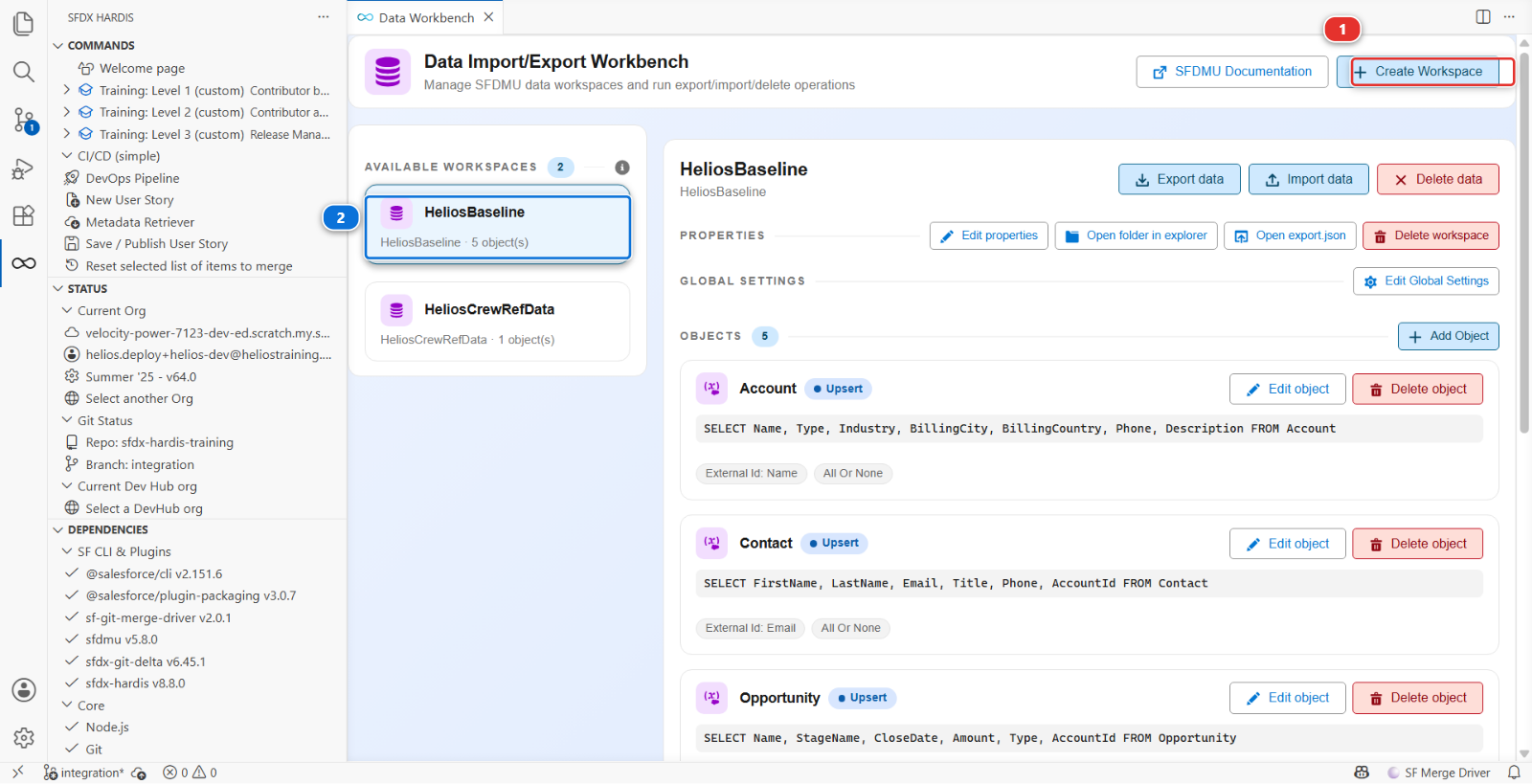
Create a new workspace named HeliosCrewRefData:
- Create Workspace, and name it
HeliosCrewRefData - Add the object
Crew_Capacity__c - Operation: Upsert
- External id:
External_Id__c - Fields: the four you created
Then Export data. It asks two questions: whether to use your default org, helios-dev, and
whether you confirm the export. Yes to both. The panel pulls your 12 records into
scripts/data/HeliosCrewRefData/Crew_Capacity__c.csv.
Open that file and read it. Twelve rows, one column per field, each with a stable external id, and
an Id column first: the record ids of helios-dev, which mean nothing anywhere else and which
the import ignores, because it matches on the external id. That file is now versioned, reviewed
and deployed like any other source. The logs, reports and target folders the export also
wrote next to it are git-ignored: nothing to commit there.
Why the external id is not optional
Upsert on External_Id__c means running the import twice updates the same twelve records
instead of creating twelve more. Without a stable external id the import is not repeatable, and
an import that is not repeatable cannot be part of a pipeline.
4. Declare the three actions
Actions belong to a Pull Request, so it has to exist first: commit the workspace, its
export.json and the CSV file, Save / Publish, and open the Pull Request. Then open it in the
DevOps Pipeline panel, Deployment Actions tab, and add three.
One: load the reference data.
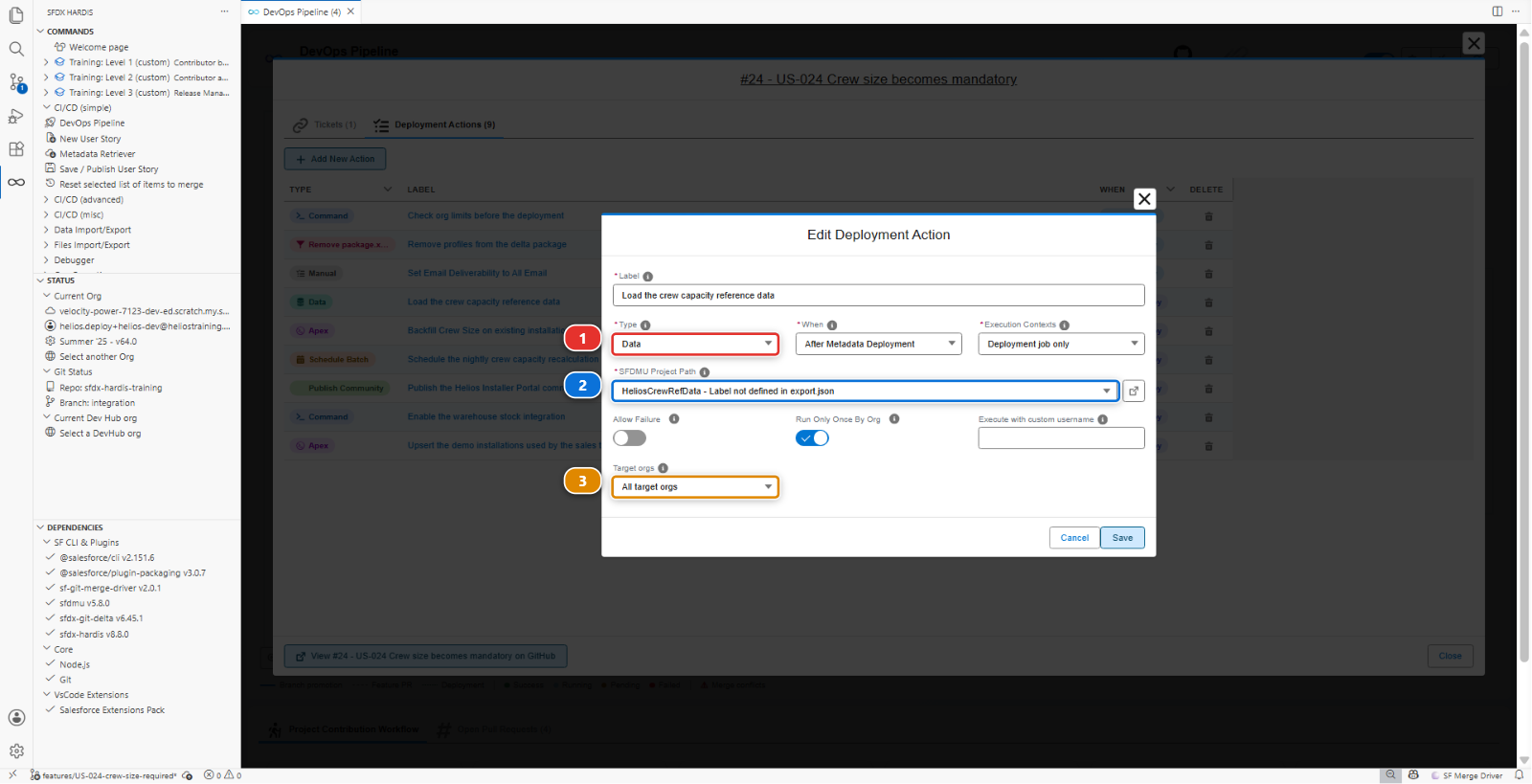
| Field | Value |
|---|---|
| Type | Data |
| Label | Load crew capacity reference data |
| When | After Metadata Deployment |
| SFDMU Project Path | HeliosCrewRefData |
| Execution Contexts | Deployment job only |
| Target orgs | All target orgs |
Deployment job only, not both jobs, because a validation job is a rehearsal: it checks the metadata and changes nothing. An import writes records for real, so it has no business running during a check.
Type (1) decides which fields the rest of the dialog shows. SFDMU Project Path (2)
is a dropdown of the workspaces under scripts/data/, so it names HeliosCrewRefData rather than
its path. Target orgs (3) on All target orgs means every org the pipeline deploys to.
Two: schedule the batch.
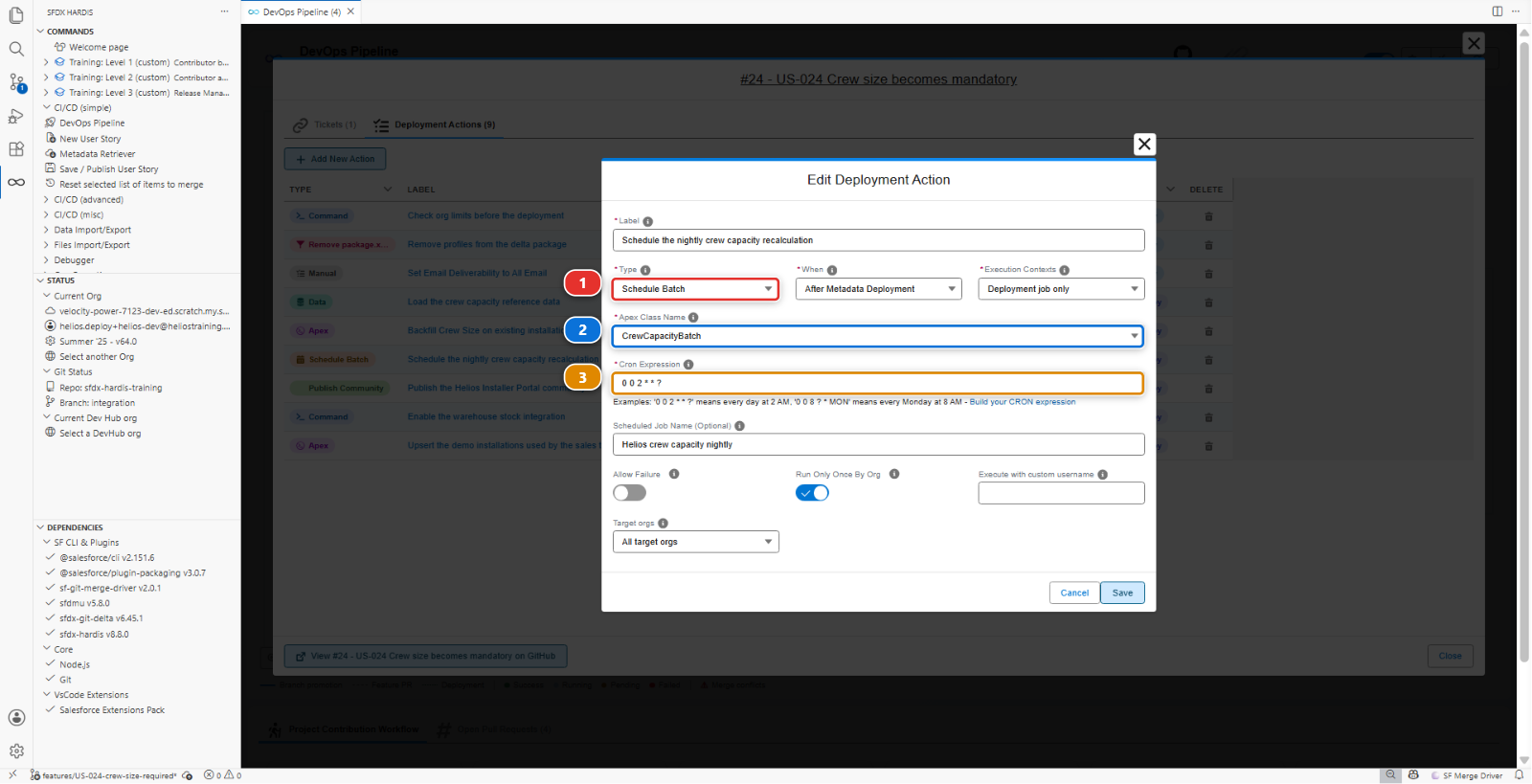
| Field | Value |
|---|---|
| Type | Schedule Batch |
| Label | Schedule the nightly crew capacity recalculation |
| Apex Class Name | CrewCapacityBatch |
| Cron Expression | 0 0 2 * * ? (every night at 02:00) |
| Scheduled Job Name (Optional) | Helios crew capacity nightly |
| Run Only Once By Org | yes |
Schedule Batch (1) replaces the script field with two of its own: Apex Class Name (2), a dropdown of the schedulable classes in the project, and Cron Expression (3), which the dialog explains with examples under the field.
Three: the one nobody can automate.
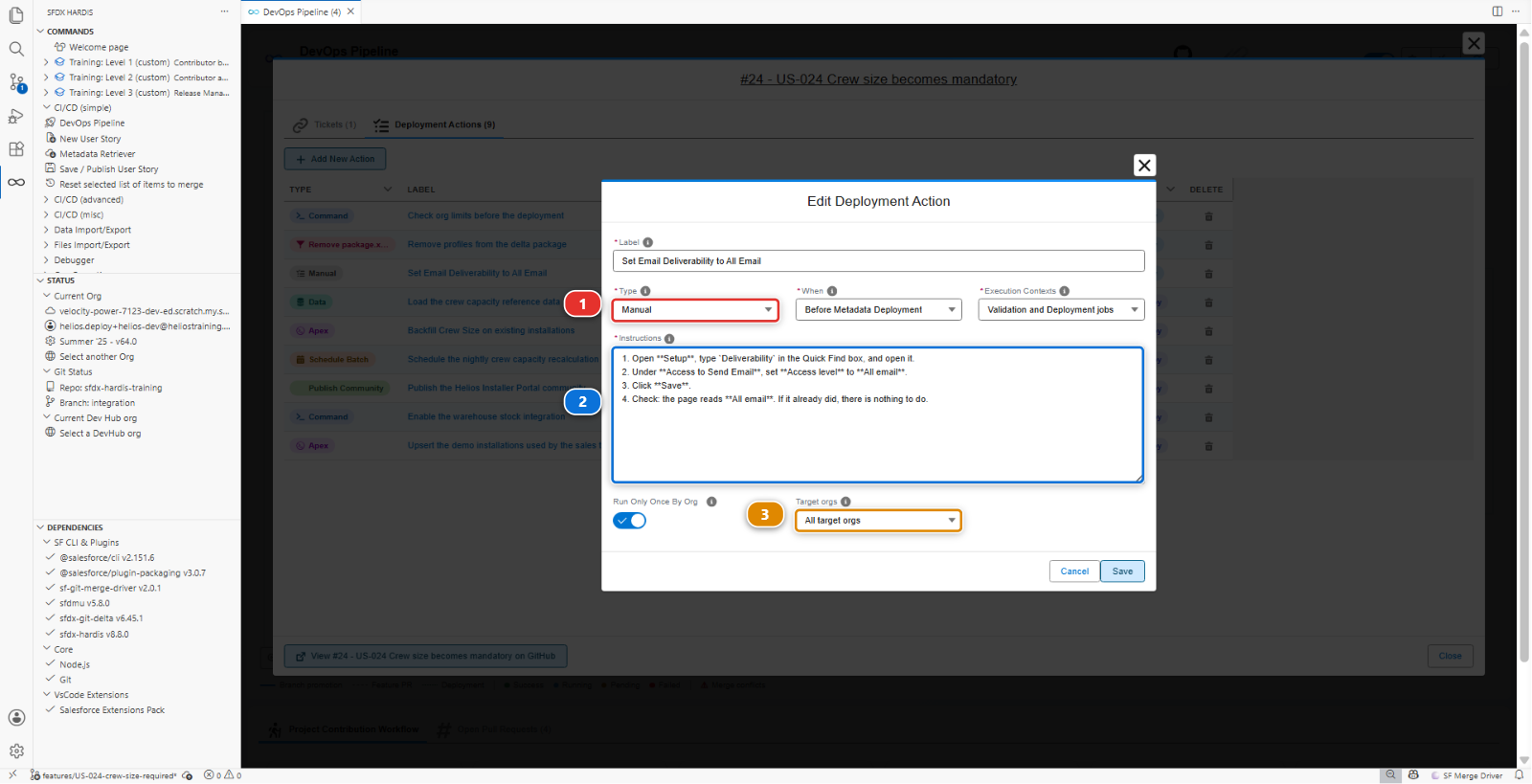
Some things have no API. Email deliverability is the best known one: whether an org may send email at all is a setting in Setup that no deployment can change. The batch emails the planner a summary when it finishes, and in an org where deliverability is not All email, that email is dropped without a word.
| Field | Value |
|---|---|
| Type | Manual |
| Label | Set Email Deliverability to All Email |
| When | Before Metadata Deployment |
| Instructions | the four numbered lines below |
| Target orgs | All target orgs |
1. Open **Setup**, type `Deliverability` in the Quick Find box, and open it.
2. Under **Access to Send Email**, set **Access level** to **All email**.
3. Click **Save**.
4. Check: the page reads **All email**. If it already did, there is nothing to do.
On your scratch orgs it already reads All email, so the step takes ten seconds. On a real project it is the step people forget: every sandbox refresh puts a sandbox back to System email only, and the first sign of it is a planner asking why the summary stopped arriving.
Manual (1) leaves one field that matters, Instructions (2), a multi-line box that takes Markdown: number the clicks, and finish with what the person should see afterwards. Target orgs (3) stays on All target orgs, because this click is needed in every org.
When is Before Metadata Deployment, unlike the two others. The org must be allowed to send email before anything that sends one arrives in it, so the person merging does this click first, then merges. A manual step declared before the deployment is listed first in the Pull Request comment, which is where they read it.
A manual step does not do anything. It appears in the Pull Request comment and in the deployment report, so the person releasing to production is told, in the release itself, that there is a click to make. That is the difference between a manual step that gets done and one that lives in a Confluence page nobody opens.
5. Read the Pull Request comment
The editor wrote the three actions into scripts/actions/, in a file named after your Pull Request.
Commit it, Save / Publish.
When the check finishes, sfdx-hardis posts a Deployment Actions comment on the Pull Request:
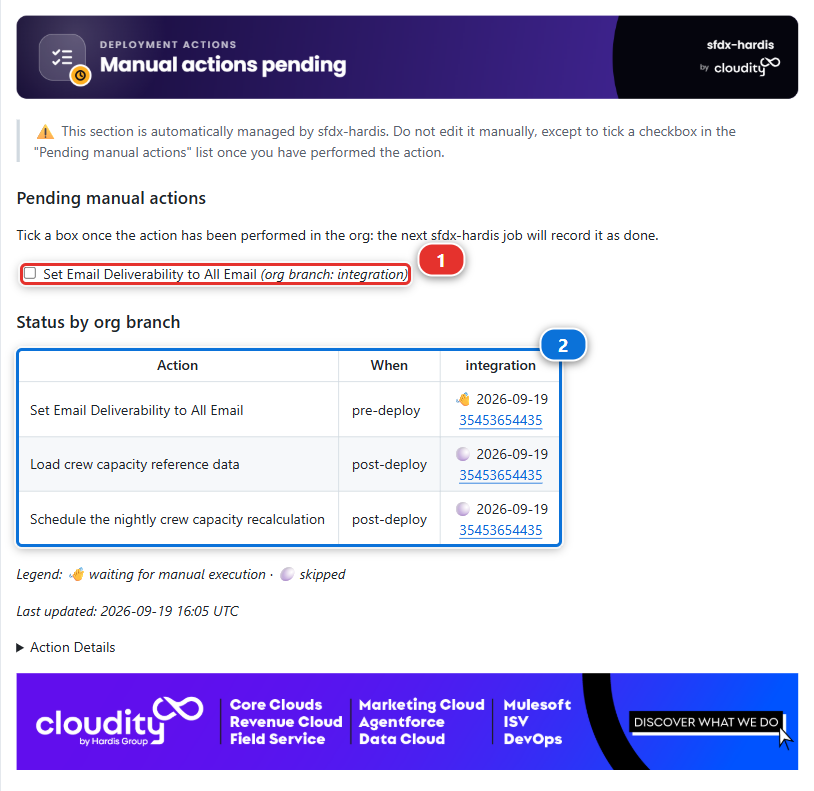
- Pending manual actions (1): your deliverability step, with a checkbox, for
integration. Do the click in the org, then tick the box: the next job records it as done - Status by org branch (2): one row per action, with its moment. The deliverability step, pre-deploy, waits for somebody; the import and the schedule, post-deploy, are marked skipped, because a check changes nothing
Merge, and watch the deployment job: the data import runs, the batch gets scheduled, and the manual step stays pending until a person says it is done.
6. Verify in the integration org
Do not take the green tick for it. Open the org and look:
- Crew Capacity has 12 records
- Setup > Scheduled Jobs lists
Helios crew capacity nightly - The manual step is listed as still to do, because you have not done it
Do the manual step by hand in helios-integration, then tick its box under Pending manual
actions in the comment on your Pull Request: the next sfdx-hardis job records it as done. That is
the point: you did it because the pipeline told you to, not because you remembered.
If the records are not there and the job was green
Read the deployment log for the line Listing Post-deployment actions. When it is followed by No post-deployment actions defined, the actions were never found, and the deployment happily carried on without them.
That happened for real while this course was being written. The CI job could not read its own git history, so the tool could not work out which Pull Requests the merge carried, and it reported no actions rather than a failure. It is fixed in this project, and sfdx-hardis now stops instead of carrying on. The habit it leaves behind is the one worth keeping: when a feature arrives empty, read the log for that line before you blame the import.
A data import succeeds when the object is missing
This one is worth knowing for the rest of your career, because it is SFDMU behaving as designed and it looks exactly like success:
[WARNING] Describe failed for {Crew_Capacity__c}: The requested resource does not exist
[WARNING] {Crew_Capacity__c} is missing in the Target.
[WARNING] {Crew_Capacity__c} Object will be excluded from the process.
[WARNING] Object set 1 has no objects to process after validation. Skipping.
===== MIGRATION JOB ENDED =====
Command succeeded.
Exit code 0 (SUCCESS).
Exit code 0. The action is reported as run, the job is green, and not one record was written. If the object never reached the org, for any reason, the import that was supposed to fill it says nothing louder than a warning nobody reads.
That is why the check in this step is the records and not the tick, and it is why those two
WARNING lines are worth searching for in a deployment log when a feature arrives empty.
The habit behind all of this: a green deployment is evidence that the metadata went in, and evidence of nothing else. The org is the only thing that tells you an action ran.
Under the hood: the three action types
All three are entries in the same YAML file under scripts/actions/:
commandsPreDeploy:
  - id: email-deliverability
    label: Set Email Deliverability to All Email
    type: manual
    parameters:
      instructions: |
        1. Open **Setup**, type `Deliverability` in the Quick Find box, and open it.
        ...
commandsPostDeploy:
  - id: load-crew-capacity
    label: Load crew capacity reference data
    type: data
    parameters:
      sfdmuProject: HeliosCrewRefData
    context: process-deployment-only
  - id: schedule-crew-capacity
    label: Schedule the nightly crew capacity recalculation
    type: schedule-batch
    parameters:
      className: CrewCapacityBatch
      cronExpression: "0 0 2 * * ?"
      jobName: Helios crew capacity nightly
    context: process-deployment-only
    runOnlyOnceByOrg: true
The data import runs SFDMU through sf hardis:org:data:import, the same command the Training menu
uses to seed your org. The schedule action runs anonymous Apex that calls System.schedule. The
manual action runs nothing at all and only produces text.
Note what they have in common: they are files in the repository, reviewed in a Pull Request, replayed identically in every org. A colleague can read the diff and see that this story needs data, a job and a click, which is information that otherwise exists only in the head of whoever built it.
What you should see
- Twelve Crew Capacity records in
helios-integration Helios crew capacity nightlyin Setup > Scheduled Jobs- The manual step listed in the deployment report, ticked off by you
If it goes wrong
The data import fails on field level security.
The CI user cannot write the fields: the grant of step 1 is missing from Helios_Delivery_Manager,
or never reached the repository. A deployment grants no field permissions to anybody by itself. Add
them in helios-dev, retrieve the permission set, and publish again.
The import creates duplicates every run.
The operation is Insert, not Upsert, or the external id is not set. Open the workspace in the
Data Workbench panel and correct both there.
The schedule action fails with Invalid cron expression.
Salesforce cron has seconds and a day-of-week field: 0 0 2 * * ?, not 0 2 * * *.
The batch is scheduled twice.
runOnlyOnceByOrg is unticked and the deployment ran twice. Delete the duplicate in Setup >
Scheduled Jobs and tick it.
Check your work
Welcome page > Training: Level 2 > Check my work, then pick Lab 2.4.
Go deeper
Next: Lab 2.5 - Pass the code quality gate and Apex test coverage